How to Plan the Week Before Your Period
If the week before your period is often harder for you, plan around an estimated window: avoid stacking deadlines you can move, prepare an important draft earlier, and leave a buffer before anything fixed. Keep the plan flexible, because your period may arrive earlier or later—and the week may feel fine.

How can you plan the week before your period?
Start with your own experience, then look at what is already on your calendar. If that week is often hard for you, choose a few changes that would make it less crowded without putting important commitments at risk.
PMS week planning doesn't require a separate kind of work for each phase. You can keep the same responsibilities while changing how much lands together, how early you prepare, and which optional plans you accept.
The useful question is: “If these days feel harder than usual, what would I be glad I'd left room for?” You don't need to assume they will be difficult to give yourself some room.
Why can the week before your period feel different?
The week can feel different because symptoms, mood, and perceived sleep can change, with wide differences between people. Across the luteal phase—the roughly two weeks after ovulation, before a period—core body temperature is about 0.3–0.4 °C higher than in the follicular phase, according to Shechter and Boivin's 2010 review, rather than rising only in the last few days. Baker and Driver's 2007 review describes self-rated sleep quality as tending to be lowest around the start of a period, while overall sleep timing and structure stay fairly stable. A small 1998 study by Schmidt and colleagues supports the idea that some people are more sensitive to the same normal hormone changes; its findings concern mood and symptoms, not work ability.
Does feeling different mean you need different work?
No. Feeling different doesn't establish that a particular phase makes you better or worse at a type of task.
A 2025 meta-analysis by Jang and colleagues found no systematic, robust differences in measured cognitive performance across cycle phases, although phase definitions varied between studies. Our guide to periods and work-performance research explains the distinction between measured ability and how difficult a day feels.
Your planning decisions can acknowledge symptoms without making a judgment about your ability. A lighter calendar can mean fewer competing demands, not lower expectations of what you're capable of doing.
Which planning changes might help if that week is often hard for you?
Consider preparing a draft earlier, protecting a buffer day, and leaving optional commitments open. Choose changes that fit your own experience and that you can reasonably undo.

Could you bring a full draft forward?
If that week is often hard for you, aim to have a usable draft before the expected harder window. “Usable” means the main pieces exist, even if they still need review.
This gives you something concrete to return to near the deadline. Bringing a draft forward only helps if there's room earlier; filling an already crowded day would simply move the pressure.
Could you protect a buffer before a fixed deadline?
If that week is often hard for you, leave a day before an important deadline with fewer other demands. A buffer is time you deliberately leave available for unfinished work or unexpected needs.
It isn't another deadline to fill with extra tasks. If the work is already ready, you can leave the space open.
Could your evenings stay lighter?
If that week is often hard for you, consider leaving some evenings without optional plans. An evening doesn't need a new purpose just because you haven't booked it.
That might mean declining an extra outing or waiting to confirm something flexible. The choice depends on whether the commitment would feel welcome or demanding to you.
Could you leave the expected first days less crowded?
If that week is often hard for you and the start of your period can be difficult too, avoid adding nonessential commitments around the expected start. You can keep something you want to do while choosing not to add more.
For the broader approach, see planning with cycle context.
How can you see the estimated week beside your deadlines?
Kiyo is a personal planner for events, to-dos, and habits. If the week before your period is often difficult for you, you can choose to view estimated cycle phases alongside your plans and decide where to leave extra time.
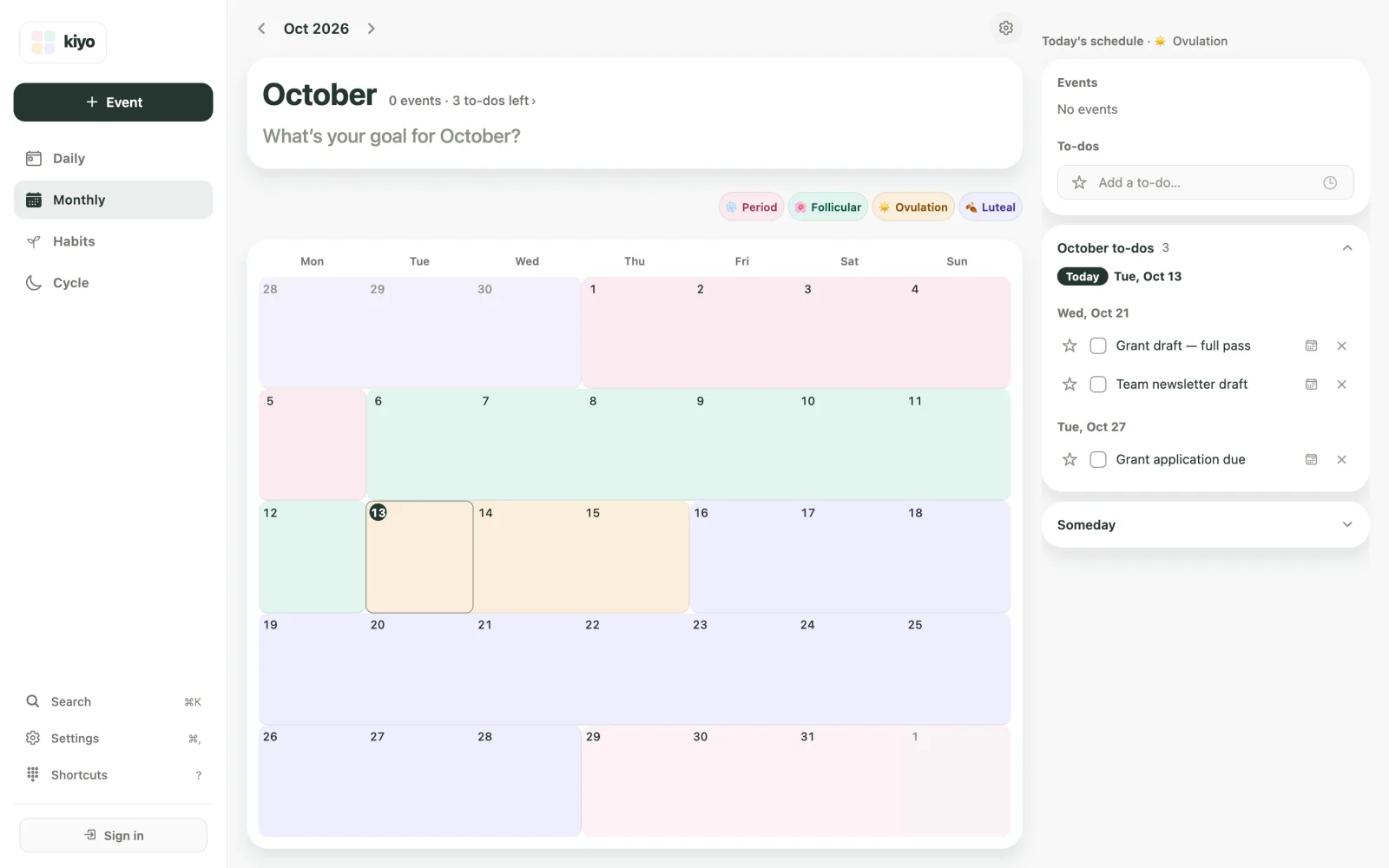
Monthly shows estimated phases as soft background colors behind the calendar, with events on their days and the month's dated to-dos listed beside the grid by date. That lets you see whether a deadline or trip falls near days that are often harder for you.
An estimated start is a planning reference, not a promise about when bleeding will begin. Leave room around it rather than treating the marked date as certain; how far to trust a period estimate explains why the next date can move.
The cycle feature is optional and off by default. In Monthly, choose Set up › on the “See your cycle on your calendar” card, review the consent screen, and answer the setup questions if you want to continue.
Kiyo shows the estimate; you decide whether to change anything. It doesn't reschedule plans by itself.
What could this look like in an actual month?
In this hypothetical October 2026 plan, the reader keeps a fixed grant deadline, prepares its draft earlier, and moves a flexible newsletter draft. She makes these choices because the week before her period is often hard for her.
Today is Tuesday, October 13. Her recorded periods were September 3–7 and October 1–5, and the demo uses a 28-day cycle with a five-day period.
The next expected start is Thursday, October 29, making the week before roughly October 22–28. She allows a few days on either side as a planning margin, not a guaranteed prediction range.
She has two commitments:
- A grant application is due Tuesday, October 27. The external deadline cannot move.
- A team newsletter draft is planned for Wednesday, October 28. That date can move.
She decides to finish a full pass of the grant application by Wednesday, October 21. Monday, October 26 stays open as a buffer for review, missing information, or work that took longer than expected.
She also moves the newsletter draft to Wednesday, October 21, because she has room for it there. If putting both drafts together would crowd that day, she could instead move it to Monday, November 2—after the expected period start, without assuming she'll feel a particular way then.
To change the newsletter's date in Kiyo, she taps the calendar icon at the end of its to-do row. In the Date and time sheet, she picks October 21 and taps Save; the existing to-do moves to that date.
She doesn't accept an optional evening event that would fall between October 28 and 30, and keeps October 29–30 light where she can. That leaves fewer demands around the expected first days without canceling the grant application or losing the newsletter task.
The point isn't to clear an entire week. It's to keep the important deadline while removing some avoidable pressure around it.
What if your period arrives at a different time—or the week feels fine?
Keep or revise the changes according to what actually happens. An earlier draft can still be useful if your period arrives late, and an open evening doesn't become wasted time if you feel well.
If the week feels fine, nothing needs to change. You can follow the lighter plan, restore a moved commitment if it still suits everyone involved, or use the open time as you choose.
If an expected start is more than 14 days overdue with no new start logged, Kiyo hides future estimates until a new start is logged; it doesn't keep extending the guess.
For decisions on a day that is already difficult, see how to plan a workday your period makes harder. To decide whether advance changes are useful over time, start with learning your own cycle pattern.
Premenstrual symptoms that regularly stop you from doing normal activities, or pain or bleeding that's unusual for you, are worth discussing with a clinician.
Common questions
Should I move all important work out of the week before my period?
No. If that week is often hard for you, keep necessary commitments and consider moving flexible work or preparing earlier. The aim is a manageable total, not an empty week.
Does feeling tired before my period mean I should avoid demanding tasks?
Feeling tired can inform how much you choose to take on, but it doesn't tell you which tasks you can do. Base changes on how you feel and your own experience, rather than assigning work to a phase.
Can I plan around PMS if my expected start date changes?
Yes, by making small, reversible choices around an estimated window. An earlier draft or an unbooked evening can remain useful even when the expected date moves.
Will Kiyo move my plans for me?
No. Kiyo records period start and end dates and shows the estimate beside your plans; it doesn't detect patterns or move anything by itself. You decide whether to move a plan and make the change yourself.