Working on Your Period: How to Plan a Harder Workday
When working on your period feels harder, keep the essential commitments, protect one useful piece of work, and move the rest to dates you choose. Your cycle doesn't set a schedule for your thinking ability, but symptoms can make a day harder. A smaller plan leaves room for that reality, including time off.

How can you make working on your period more manageable?
Start with how you feel today and what actually needs to happen. If you feel fine, the original plan stands; if cramps, poor sleep, or low mood make the day harder, you can ask less of it.
Three findings help explain why that distinction matters:
- Measured thinking ability doesn't follow a phase-based schedule. A 2025 meta-analysis found no systematic differences in cognitive performance across cycle phases; our guide to period and work-performance research explains what that finding does and doesn't mean.
- Sleep can feel worse around a period. A 2007 review reported that self-rated sleep quality was lowest around the start of a period, while sleep timing and structure stayed fairly stable.
- Much of the reported loss happens while people keep working. In one large Dutch survey published in 2019, lost productivity from working while unwell was equivalent to 8.9 days a year, compared with 1.3 days of absence.
That survey included work and school, used self-reports, and recruited through social media. Its averages aren't a forecast for your workday. Presenteeism means working while unwell: being present doesn't necessarily mean the day is manageable.
Resting, canceling, or taking leave is an equally valid plan. Arranging that is part of responding to the day, not failing it.
Pain that stops your normal activities, or pain or bleeding that is new or unusual for you, is a reason to see a clinician.
What should a smaller workday protect?
Protect one useful outcome, reduce the day's total, and give the remaining work somewhere to go. The aim is to get through what matters without treating the original list as a debt you must clear today.
If you need a starting point, sort today's list into fixed, due and flexible items, then make these choices.
Protect one thing. Choose a piece of work small enough to name clearly: “draft the report's findings” rather than “catch up.” A fixed appointment may still need to happen, but the protected task gives the rest of the day a clear stopping point.
Lower the total rather than your standard. Keep the care the work needs; reduce how much you're asking yourself to deliver. A first pass today and a careful review tomorrow can be a deliberate plan when the deadline allows it.
Leave space between commitments, too. An empty gap doesn't need a replacement task simply because it appears available.
Move instead of dropping. Give a task another date if it needs one, or leave it undated if it doesn't. Moving work means changing when you intend to return to it while keeping the task itself.
Kiyo is a personal planner for events, to-dos, and habits. If work feels harder during your period, you can keep the events you need to attend, set aside time for one to-do, and give the rest later dates.
In Daily, fixed-time events appear as filled timeline blocks, while to-dos have their own list. That distinction lets you see what has a set time and what you can choose to move.
What could a workday with period cramps look like?
A smaller pain-day plan could keep an essential call, protect a first pass on a report, and move everything else. Here's a hypothetical Tuesday, October 13, 2026—not a routine to follow whenever your period starts.
You wake with cramps. A client call runs from 10:00–10:45 and can't move; a report is due Wednesday. Your list also contains “Update project tracker,” “Reply to vendor about Q1,” and “Tidy shared drive.”
For this example, you've decided to work a smaller day.
- Keep the client call. Leave it as an event from 10:00–10:45. You don't need to make the rest of the morning equally full.
- Protect the report's first pass. Name the to-do “Report — first pass” and give it a time of 13:00–14:00. In Kiyo, the timeboxed to-do appears as an outlined block on the timeline and stays in the TO DO list. Aim to get the main findings and missing pieces down; leave polish for Wednesday morning if needed.
- Leave gaps around commitments. Book nothing immediately after the call. The gap is room to stop and reassess, without another promise starting the moment the call ends.
- Move the flexible work. For “Update project tracker,” tap the calendar icon at the end of its row, open Date and time, choose Thursday, October 15, and tap Save. Move “Reply to vendor about Q1” to Friday, October 16, the same way. For “Tidy shared drive,” which has no real deadline, turn on Someday at the top of the sheet and save; it waits without a date in Monthly's Someday list.
- Reconsider only if you want to. If the pain eases in the afternoon, you can open a moved to-do on its new date and set its date back to today, or simply do it. Feeling better doesn't oblige you to refill the gaps.
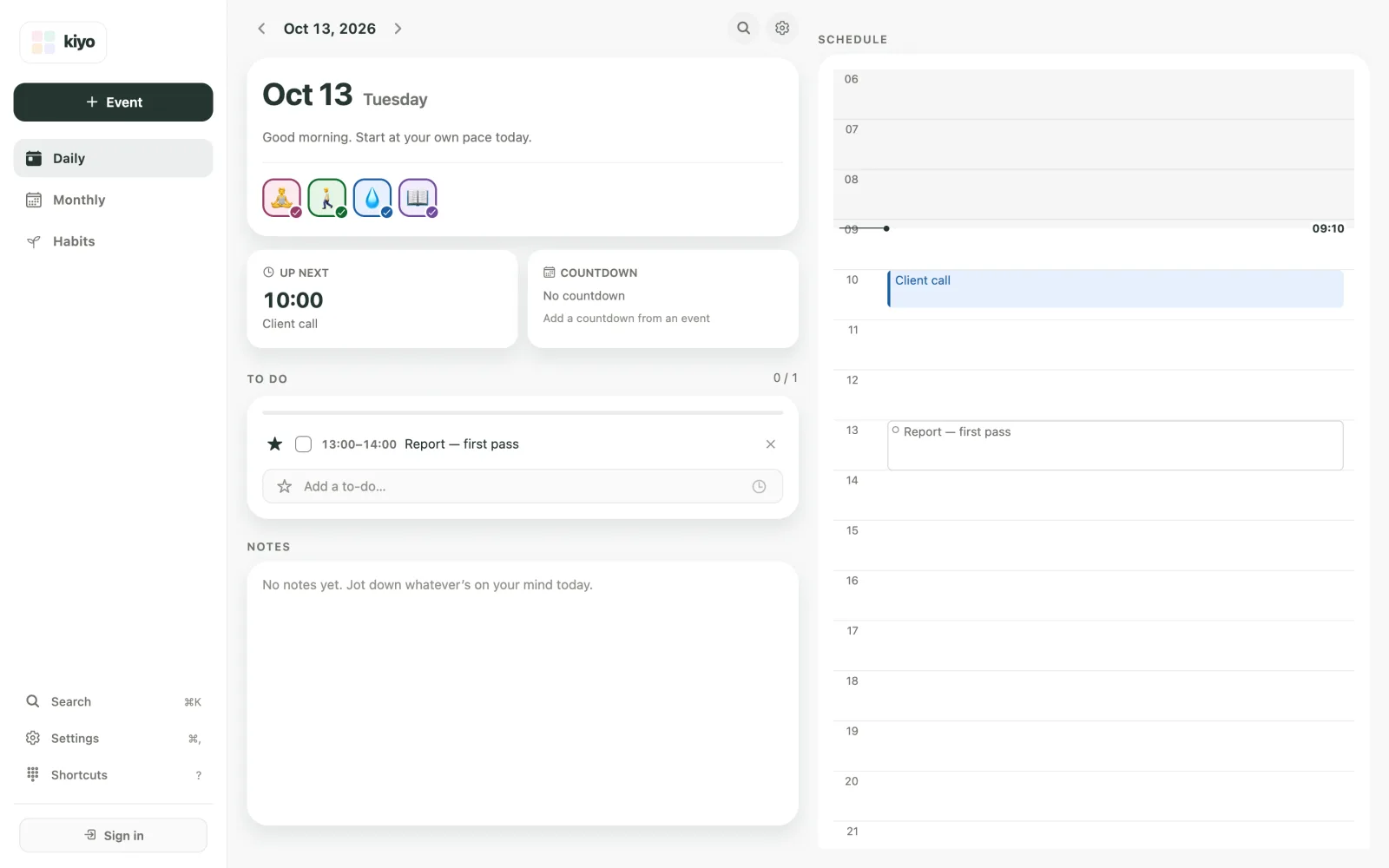
The plan is a ceiling, not a quota: it limits what you've committed to, without requiring you to complete it at any cost. If the day becomes harder, you can revisit the call or report commitment and arrange a change.
The moved to-dos haven't been deleted or recreated. They're still there for the dates you chose, and the undated task still has a home.
How can you prepare for another harder day?
Use your own experience to leave room ahead of time, while keeping estimates provisional. If you turn on Kiyo's optional cycle feature, Monthly shows your estimated cycle as soft colors behind the calendar, beside your commitments; it doesn't forecast energy, detect symptoms, or move plans for you.
If a certain week is often hard for you, start with planning the week before your period. For a less predictable experience, explore learning your own cycle pattern and how far to trust a period estimate before changing commitments.
Common questions
Should I change my work plan whenever my period starts?
No. If you feel fine, keep your plan; an estimated phase alone isn't a reason to change your tasks. Adjust the day when your actual experience calls for it.
What if I can't move a meeting or a deadline?
Keep that constraint visible and reduce the surrounding commitments where you can. If the essential work itself isn't manageable, asking to change the commitment or arranging time off is a valid next step.
Does moving a to-do mean I'll have twice as much to do tomorrow?
It doesn't have to. Choose a later date with room, rather than sending everything to tomorrow; use Someday for work that has no real date.
What happens if I skip a habit on a harder day?
In Kiyo, a skipped day breaks the current streak, but past check-ins, completion rate, and longest streak remain. Your habit history survives a broken streak, so returning doesn't mean starting from nothing.