How Period Apps Predict Your Next Period, and How Much to Rely on the Date
Most period apps predict your next period by adding your usual cycle length to the first day of your last period. That makes the date an estimate, not a booking: cycle length varies by a few days for most people, and more if cycles are irregular. Plan around a range of days, not one date.

How do period apps calculate your next period?
Most apps start with the same calculation: add your typical cycle length to the first day of your last period. If your last period started on October 3 and your cycles usually run 29 days, the next one is expected around November 1. The period calculator does the calculation for you.
Apps differ in what they treat as "typical." At first it's usually the number you enter. Once you've logged a few periods, an app can instead use the average or median length of your recent cycles. Some add other data: Apple says Cycle Tracking bases period predictions on the periods and cycle lengths you've logged, and that wrist temperature from a recent Apple Watch can improve period predictions.
Whatever the method, two things limit any estimate: how many cycles you've logged, and how much your cycles vary.
How does Kiyo estimate your next period?
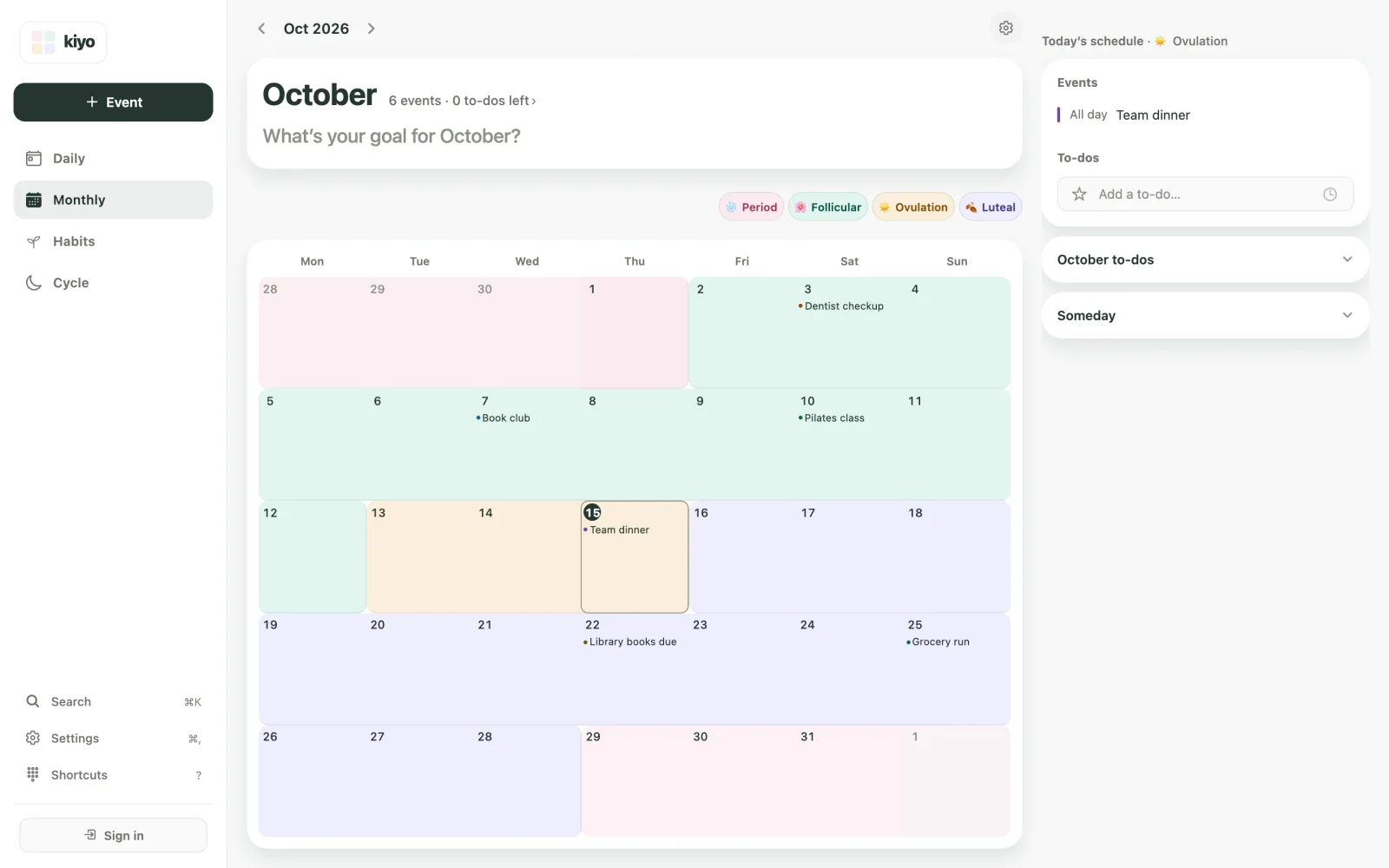
Kiyo is a personal planner for events, to-dos and habits on the web and iPhone. Turn on Cycle syncing to see your estimated cycle as a color layer behind your plans. This feature is off by default. Kiyo uses the average cycle length you enter until you've logged four period start dates. From then on, it uses the median of your most recent cycles, up to six.
| Until you have enough records | Once you do | |
|---|---|---|
| Cycle length | The average you enter at setup (28 days unless you change it) | The median of your last cycles, up to six, from your fourth logged start date |
| Period length | The number of days you enter at setup | The median of your last periods, up to six, once three have end dates |
| Next expected start | Your last logged start plus the cycle length | Same |
| Ovulation phase | Cycle day (cycle length − 14), shaded as a three-day window | Same |
The ovulation window assumes a 14-day luteal phase—the time between ovulation and the next period. It's a calendar estimate for planning, not a fertility signal. On the calendar, the cycle that starts from a period you logged is in full color, and estimated future cycles are paler, so you can tell a record from an estimate.
Why a median, not an average?
One unusual cycle barely moves a median, and so does a missed period entry. Suppose your last six logged start dates give five cycle lengths: 27, 28, 29, 30 and 52 days. The 52-day gap actually covers two cycles because you missed logging one start date:
| Method | Cycle length | Next expected start after an October 3 start |
|---|---|---|
| Average | 33.2 days | Around November 5 |
| Median | 29 days | November 1 |
Before you've logged four start dates, the estimate uses the average you entered during setup. That's why early estimates are the roughest.
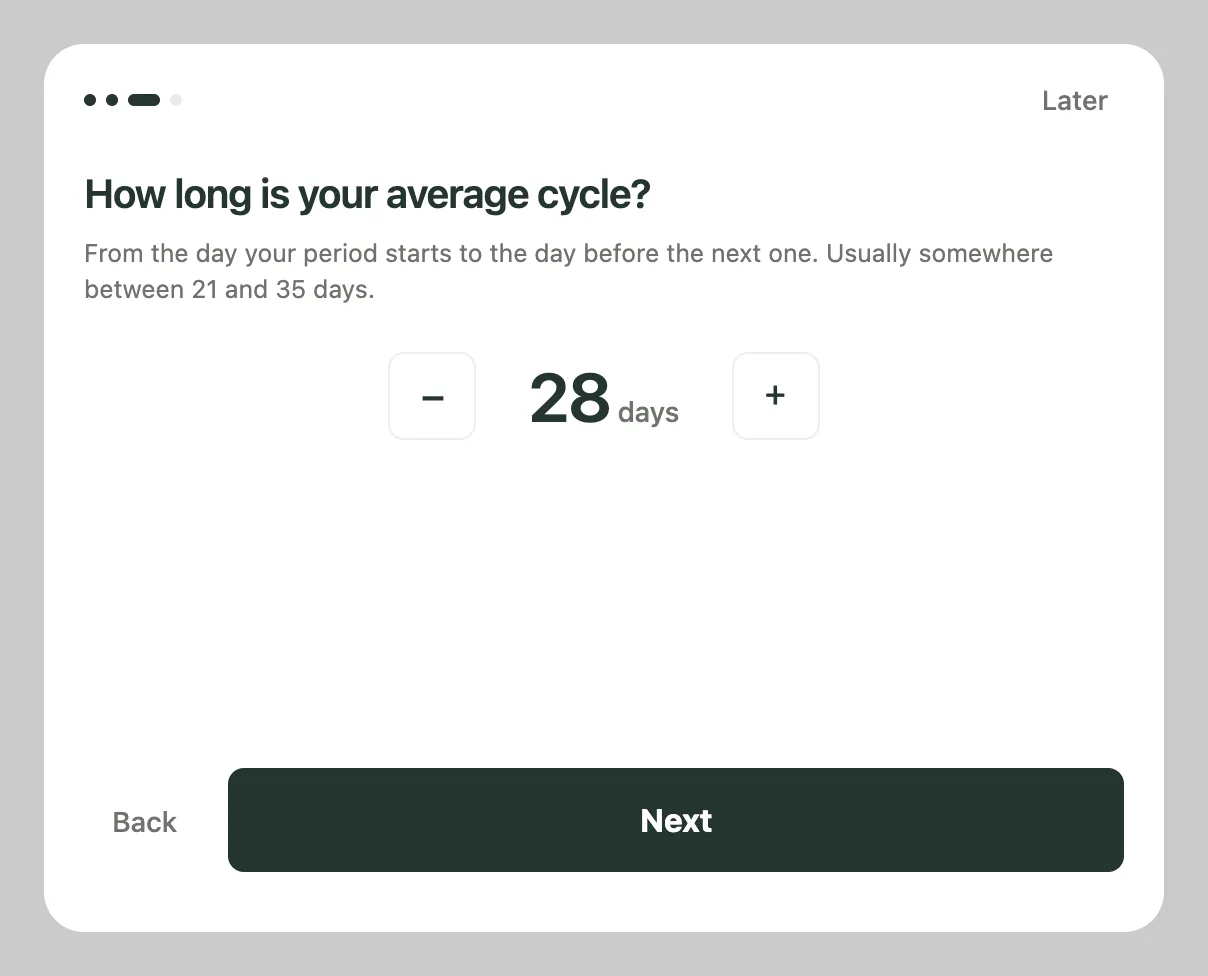
When Kiyo starts using your records to calculate cycle or period length, the corresponding Settings row—Average cycle length or Average period length—shows "Calculated automatically from your cycle records." instead of an editable number.
Why does the expected date move?
Because cycles vary, even for people who think of theirs as regular. In 612,613 cycles from 124,648 users of a cycle-tracking app, Bull and colleagues (2019) found:
- The average cycle was 29.3 days, and only 13% of cycles were exactly 28 days.
- 65% of cycles were between 25 and 30 days.
- Each person's own cycle length varied too: the average per-person standard deviation was 2.6 days.
- The luteal phase averaged 12.4 days, not 14, with a range the authors report as 7 to 17 days. How the follicular and luteal phases fit together explains what that phase is.
The NHS puts the average gap between periods at around 28 days and says it "can sometimes be a bit shorter or longer." It calls periods irregular when the gap is less than 21 days or more than 35, and lists causes including stress and anxiety, losing or gaining a lot of weight, exercising too much, and some hormonal contraception. Kiyo's consent screen also notes that estimates may be less accurate if you use hormonal birth control or receive hormone therapy.
The date also moves whenever you log a start. Kiyo counts forward from your most recent logged start, so each new entry becomes the basis for the next estimate.
What happens if your period is late?
Kiyo asks rather than guesses. From the expected date, Daily shows Has your period started? with Yes and Not yet. Yes lets you log the start date. Not yet hides the question, and Kiyo asks again two days later.
Until you log a start, Kiyo doesn't mark a period on days that have already passed. Instead, it keeps moving the expected period forward to start the next day. The Cycle screen counts the days, for example "Day 36 of your cycle · Period expected 7 days ago."
If 14 days pass after the expected start with nothing logged, the Cycle screen shows Period expected 14 days ago with "No new start logged. If it's started, log the date." Monthly hides future estimates and shows "Future cycle estimates are hidden until a new start is logged." The colors on past days remain visible. This works the same on the web and in the iPhone app (version 1.2.4 and later), and the 14-day mark is a product choice, not a medical threshold.
A late period can have many causes, and Kiyo can't tell you why one is late. The NHS says late or missed periods are mostly nothing to worry about, and suggests seeing a doctor if you've missed three periods in a row or your periods have become irregular.
How do you plan around an expected date?
Ask one question about each plan near the expected date: would it still work if your period started a few days earlier or later?
| Kind of plan | Example | How to plan it |
|---|---|---|
| Fixed booking | A flight, an exam, a medical appointment | Keep the date and leave some slack around it |
| Flexible task | A deep clean, a long errand | Keep it movable, or undated until the week arrives |
| Optional plan | Drinks after work, a long hike | Decide closer to the day |
For trips, see how to plan a trip around an estimate. For planning a busy week, see cycle syncing in everyday planning. And for why Kiyo shows the estimate behind your plans rather than as another entry, read why your cycle is context, not a calendar event.
What can't a period estimate tell you?
It can't confirm ovulation or fertile days, it isn't birth control, and it can't tell you how you'll feel on a given day. Kiyo's cycle information is intended as a general reference for planning. Its notice also says this information should not be used as a form of birth control. If your periods change or something about them worries you, talk to a doctor or another healthcare professional.
How cycle context works in Kiyo covers the rest of the feature, and if you'd rather keep records on a computer, see how to track your period online.
Common questions
How accurate are period tracker predictions?
Treat them as a range, not a date. Accuracy depends mostly on how regular your cycles are and how many you've logged. In a study of more than 600,000 cycles, the average per-person standard deviation in cycle length was 2.6 days.
Why does my period app keep changing my predicted date?
Because each start date you log updates the calculation. Kiyo bases each estimate on your latest logged period start date. From your fourth logged start date onward, it also recalculates your cycle length using the median of your recent cycles.
How many cycles does an app need before predictions improve?
It depends on the app. Kiyo uses the average you enter until you've logged four period start dates, which is three full cycles, then switches to the median of your most recent cycles, up to six.
Can a period prediction tell me when I'm ovulating or fertile?
No. A calendar estimate can't confirm ovulation or fertile days. Kiyo's ovulation phase is an estimate for planning only, and it shouldn't be used as birth control.
What if my period hasn't started by the predicted date?
Log the start date when it comes. Starting on the expected date, Kiyo asks whether your period has started. If 14 days pass without a new start logged, it hides future estimates until you log one. If you've missed periods or they've become irregular, talk to a doctor.