How Many Phases Does the Menstrual Cycle Have?
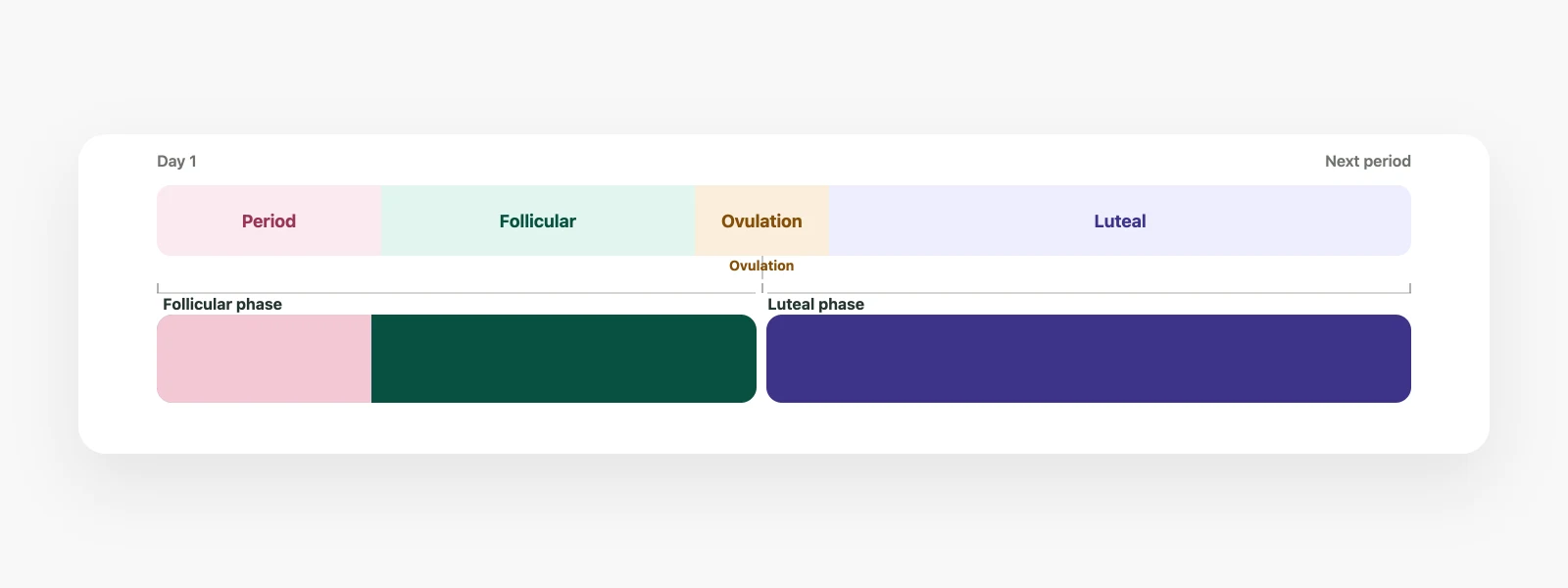
The ovarian cycle has two phases: menstruation starts the follicular phase; ovulation starts the luteal phase. Kiyo, a personal planner for events, to-dos and habits on the web and iPhone, and many cycle apps display four names—Period, Follicular, Ovulation and Luteal—over those two ovarian phases.

How many phases are in the menstrual cycle?
In ovarian physiology, the cycle has two main phases: follicular and luteal. The four-name view used by Kiyo and many cycle apps highlights parts of that same cycle so they’re easy to recognize on a calendar.
These are different levels of description. The two-phase view describes the ovarian cycle; the four-name display gives bleeding and the time around estimated ovulation their own labels.
That distinction helps answer two everyday questions: why some people feel better once their period starts, and why a longer period doesn’t automatically push the next one back. You don’t have to choose one picture and discard the other.
What’s the difference between the follicular and luteal phases?
The follicular phase is the part of the ovarian cycle that begins on the first day of your period and ends at ovulation. The luteal phase is the part that follows ovulation and continues until the next period begins. Cleveland Clinic notes that the follicular phase overlaps with menstruation and ends at ovulation.
Menstruation belongs within the follicular phase, even though a calendar may label those days separately as “Period.” Day 1 begins with menstrual flow; the follicular phase doesn’t wait for bleeding to finish. StatPearls explains this overlap.
The two phases also differ in how much their length tends to vary. Endotext identifies the follicular phase as the main source of cycle-length variation, while the luteal phase is relatively stable.
“Relatively stable” doesn’t mean identical for everyone. Cleveland Clinic gives an average luteal length of 12–14 days and considers 10–17 days normal. About two weeks is a useful description, with room for substantial individual differences.
Why does Kiyo show four cycle names?
Kiyo shows Period · Follicular · Ovulation · Luteal to make the calendar readable. Those names mark bleeding, the bleeding-free stretch before estimated ovulation, an estimated ovulation window and the days after that window.
“Follicular” therefore has a broader meaning in physiology than it does as a separate calendar label. Physiologically, it includes your period; in Kiyo’s four-name display, bleeding gets the more immediately recognizable label “Period.”
Likewise, Kiyo’s “Ovulation” label covers a three-day estimated window. It doesn’t mean ovulation itself is a separate three-day ovarian phase, or that the app has observed it happening.
The display gives you context alongside your plans. For the distinction between that background and a scheduled item, see why your period isn’t a calendar event.
Why might I feel better when my period starts?
Some people may feel better because premenstrual symptoms ease once bleeding begins. Others may find the first days hardest because of cramps or heavy flow; both experiences are common.
The U.S. Office on Women’s Health says PMS symptoms “go away within a few days after a woman’s period starts as hormone levels begin rising again.”
Your period marks the start of the follicular phase. The Office on Women’s Health links the easing of PMS symptoms to hormone levels beginning to rise again. That offers a plausible hormonal backdrop, but it doesn’t explain why any particular person feels better on a particular day.
There’s no requirement to feel better immediately. Cramps can make the first days harder, and heavy bleeding can affect everyday activities. Relief from one symptom and discomfort from another can both matter when you look at your day.
A phase name can’t tell you how much energy you have. Kiyo doesn’t measure, score or predict energy; what matters for your plans is how you actually feel.
Does a longer period mean a longer menstrual cycle?
A longer bleed does not necessarily mean a longer cycle or a later next period. Period length counts bleeding days; cycle length measures the interval from one period’s start to the next. Endotext defines cycle length by those start dates.
If you usually bleed for five days and this time bleed for nine, those extra days can still sit within the follicular phase. The bleeding-free part before ovulation may be shorter, while the overall cycle length stays the same.
That’s a possibility, not a promise about what your body will do. Individual differences are large, and bleeding duration alone doesn’t establish when ovulation happened or when your next period will begin.
There’s also a separate health question. Bleeding longer than about seven days, or a sudden change in your usual pattern, is a reason to talk to a doctor. ACOG lists bleeding that lasts more than seven days as abnormal, along with cycle lengths that vary by more than seven to nine days.
The NHS lists periods lasting more than seven days as a sign of heavy periods and advises seeing a doctor when heavy bleeding persists, affects your life or comes with severe pain. An unchanged calendar estimate doesn’t answer whether a change in bleeding needs care.
What happens in Kiyo if a five-day period lasts nine days?
In this example, recording nine bleeding days extends the “Period” display without moving the cycle day, cycle length, estimated ovulation or next expected start. Only the bleeding-free “Follicular” stretch shrinks.
Suppose Maya uses a 28-day cycle estimate and usually records five bleeding days. This time, she records bleeding through day 9. Here’s how Kiyo’s display compares:
| Calendar detail | Five-day bleed | Nine-day bleed |
|---|---|---|
| Period | Days 1–5 | Days 1–9 |
| Bleeding-free Follicular display | Days 6–12 | Days 10–12 |
| Estimated ovulation day | Day 14 | Day 14 |
| Ovulation display window | Days 13–15 | Days 13–15 |
| Luteal display | Days 16–28 | Days 16–28 |
| Next expected start | Day 29 | Day 29 |
These are Kiyo’s display spans. The “Luteal” label starts after the displayed ovulation window; the physiological transition is at ovulation.
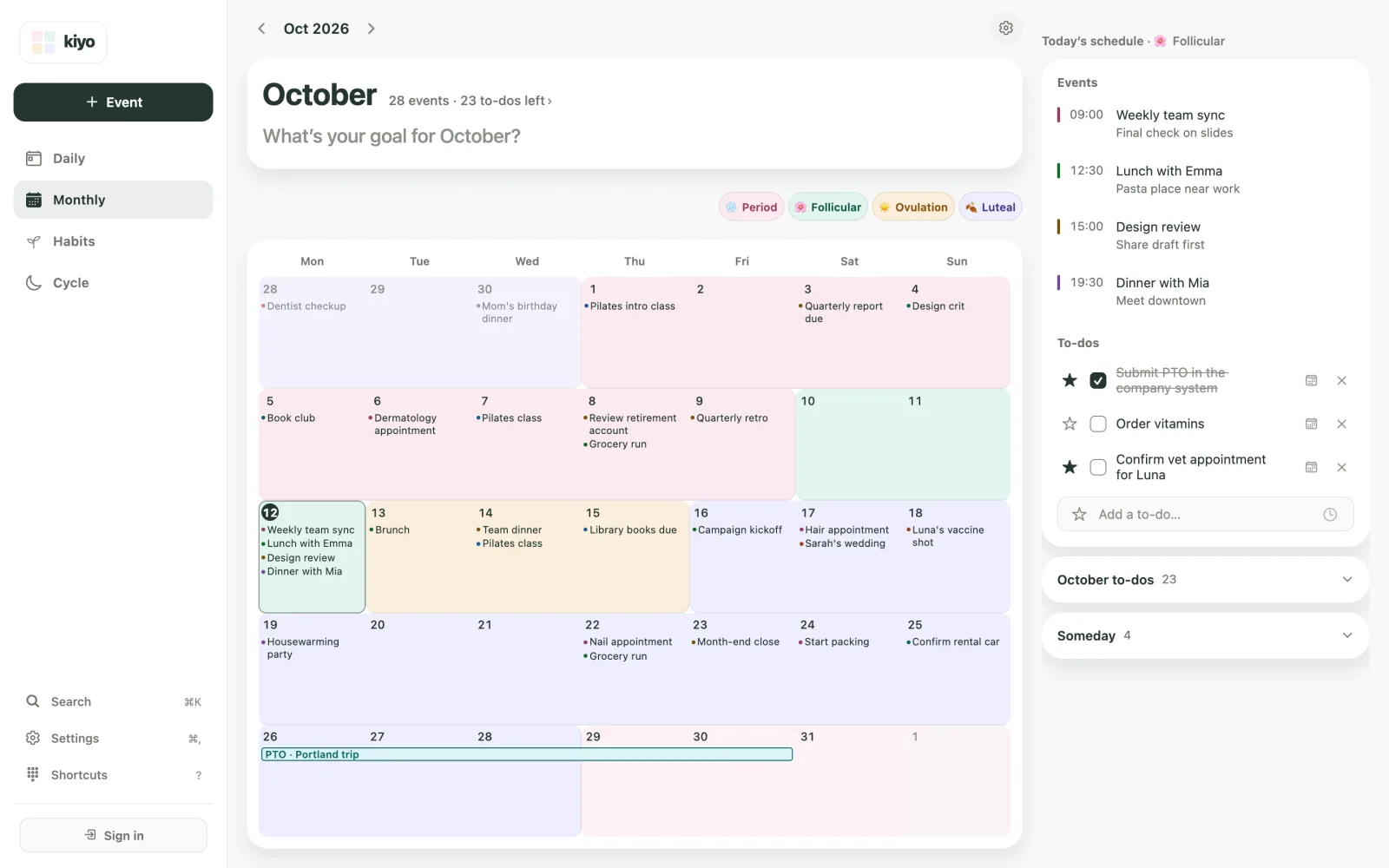
Maya’s cycle count continues from the same recorded start. Recording the last bleeding day changes what happened within that cycle; it doesn’t add four days to the cycle-length estimate.
Kiyo bases cycle length on start-to-start gaps, rather than bleeding duration. Its ovulation estimate assumes a 14-day luteal phase, placing estimated ovulation 14 days before the next expected start; the reader’s real ovulation can differ.
If recorded bleeding overlaps the estimated ovulation window, the bleeding record takes priority in the display. A calendar label is an estimate, while recorded bleeding is information you supplied.
For the limits of these dates, read how much to rely on a period estimate.
How can I use this distinction when planning?
Use the phase display as background, then make decisions from your actual symptoms, commitments and preferences. You don’t need to match your day to a phase description.
For Maya, the useful information is specific: she’s still bleeding, the app’s next expected start hasn’t moved, and she can decide whether her current plans leave enough room for how she feels. None of those observations requires assuming a particular level of energy.
For everyday examples, see planning with cycle context.
Kiyo’s optional cycle view shows the estimated cycle alongside your plans, with consent before setup.
This information is general education, not medical advice, diagnosis or treatment. Kiyo’s cycle estimates should not be used for contraception or pregnancy planning.
Common questions
Is my period part of the follicular phase?
Yes. Menstruation occurs within the follicular phase, which begins with your period and continues until ovulation; a separate “Period” label simply makes bleeding visible in an app’s display. StatPearls describes the overlap.
Is the luteal phase always 14 days?
No. The luteal phase is relatively stable, but Cleveland Clinic gives an average of 12–14 days and a normal range of 10–17 days. Kiyo uses a 14-day assumption for its estimate, which may differ from your actual timing.
Why do I feel better when bleeding begins?
Premenstrual symptoms may be easing: the Office on Women’s Health says PMS symptoms go away within a few days after a period starts. Others may feel worse because of cramps or heavy flow, so the phase name alone doesn’t describe your experience.
Will recording a nine-day period move my next expected start in Kiyo?
In the 28-day example above, no: extending recorded bleeding from five to nine days leaves the next expected start on day 29. It shortens the bleeding-free Follicular display, while the cycle count and estimated ovulation stay unchanged.