Why Cycle Averages May Not Fit You—and How to Find Your Pattern
Cycle phase charts may not match how you feel because averages hide differences in both timing and sensitivity to normal hormone changes. Your own dates and brief daily notes, kept across a few cycles, can help you notice whether harder days recur. A phase label isn’t a forecast of your day.

Why don't cycle phase charts match how I feel?
A generic chart describes a shared outline, not your personal experience. It can’t tell you exactly when a phase falls for you or how you’ll feel during it.
There are two separate questions here: “Where might I be in my cycle?” and “What does that usually feel like for me?” An estimated phase addresses the first; it doesn’t answer the second.
Cycle and phase lengths vary, so a chart’s tidy boundaries may not fit your dates; our guide to how far to trust a period estimate explains that timing uncertainty.
Even when the timing fits, the feeling may not. Many people feel differences in energy and mood; how much varies widely. There’s no need to make your experience agree with a chart before you take it seriously.
A useful personal pattern is a change you notice repeatedly in your own records, with room for exceptions. It’s a reason to leave yourself options, not a rule about what you can do.
Can people respond differently to the same hormone changes?
Yes. Some people are more sensitive to the same normal hormone changes, so similar hormonal conditions don’t necessarily produce similar symptoms.
In a small 1998 study by Schmidt and colleagues, suppressing ovarian hormones relieved symptoms in participants with PMS. Adding back estradiol or progesterone brought symptoms back in that group but caused no mood change in participants without PMS.
The finding concerns mood and symptoms in a small study. It doesn’t establish a schedule for work, creativity or concentration, and it doesn’t tell you which days will be hard for you.
That distinction matters when a chart attaches a personality or a task list to each phase. Feeling less comfortable or more easily upset isn’t itself a measurement of your ability. For that separate question, see the research on periods and work performance.
Why are repeated records more useful than a group average?
Repeated records let you compare yourself with yourself. A group average can blur changes that happen at different times or to different degrees in different people.

The 2021 research guide by Schmalenberger and colleagues treats cycle effects as changes within a person and recommends repeated daily measurements. The question is how someone’s experience changes across their own cycle, rather than whether they resemble an average participant.
For everyday planning, that suggests a modest approach: write down what happened before trying to explain it. “Slept poorly; presentation still went fine” preserves more useful detail than “This phase is bad for work.”
Prospective records are notes made as days happen, rather than reconstructed afterward. In clinical research, this distinction has a specific role: a 2024 review by Reilly and colleagues distinguishes confirmed PMDD diagnoses, based on prospective daily ratings over two cycles, from provisional diagnoses.
Your everyday notes have a different purpose: helping you remember your experience and consider your plans. They aren’t a self-diagnosis exercise, and a brief planning note doesn’t replace clinical assessment.
What should I record to learn my own pattern?
Start with period start and end dates, then add a brief daily note elsewhere if you want to understand how days felt. Keep the record small enough that you’re willing to continue across a few cycles.
Try this:
- Record when each period starts and ends.
- In any notebook or notes app, write a line about how the day felt.
- Include ordinary days, not only difficult ones.
- Note relevant details of the day, such as a late night, a deadline or a lighter schedule.
- Look back at what you actually planned around those dates.
A note could be: “Tired after a late night; kept the appointment, moved laundry.” Another could be: “Expected a difficult day; felt fine and followed the original plan.”
You don’t need to assign every feeling to your cycle. Keeping other circumstances in the note leaves room for more than one explanation.
Give it at least a few cycles before treating something as a planning clue. One cycle is a sample of one; an exception is useful information too. If no clear pattern appears, you can still make decisions from how you feel today.
If symptoms are severe or regularly stop you from doing normal activities, bring your dates and notes to a clinician.
What can Kiyo show while I build my records?
Kiyo can put recorded period dates, estimated phases and your plans in view; you decide what they mean. Kiyo is a personal planner for events, to-dos, and habits. With the optional cycle feature enabled, you can use Cycle to review your average cycle length, average period length, and range of recent cycle lengths as you look for patterns in your own records.
The cycle feature is optional and off by default, with consent before setup and no account needed. Kiyo records period start and end dates. In Monthly, soft background colors show estimated phases behind the calendar, beside your events, with the month's dated to-dos listed next to the grid.
In the Cycle tab, Cycle stats shows Avg. cycle, Avg. period and Cycle range, using up to the six most recent completed cycles. Averages are available once at least 4 cycle start dates are logged. The range shows your shortest and longest recorded cycles in that set, so you can look beyond the average.
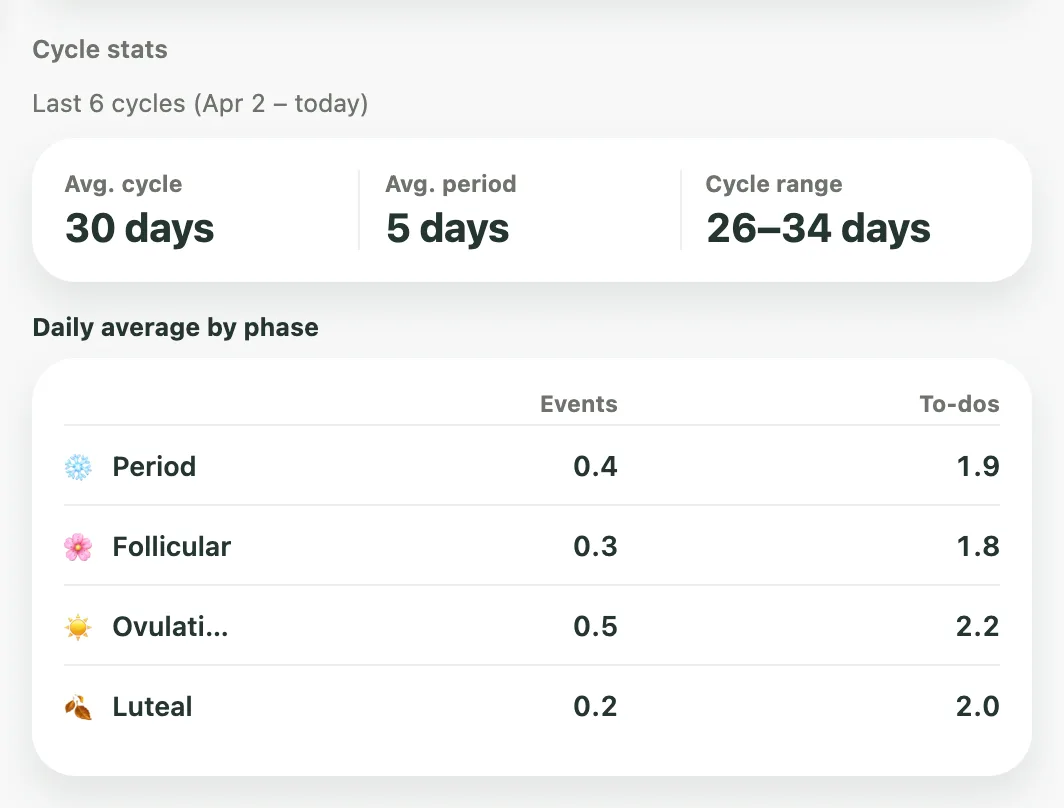
Daily average by phase appears from one completed cycle and shows the average number of events and to-dos scheduled per day in each phase. It describes how much you planned—not how much you finished, how difficult it was or what you’re capable of doing.
Kiyo doesn’t detect patterns, generate insights or give a normal/irregular verdict. Keep any notes about how days feel in a notebook or notes app, and compare them yourself with your dates and plans.
What might learning a pattern look like in practice?
It might look like a tentative observation followed by a small planning choice. You don’t need a rule for every phase.
Consider this fictional record, kept across several months in 2026:
- July: a period starts July 28. Notes from July 26–27 mention poor sleep and feeling irritable; the calendar also shows a tight deadline.
- August: a period starts August 31. August 29 feels difficult, but the next day feels ordinary.
- September: a period starts September 28. Notes from the preceding days don’t mention the same difficulty.
The observation is narrow: “Some days shortly before my period have felt harder, but not every time.” The record doesn’t establish that the cycle caused each difficult day or that the next expected period will follow the same pattern.
For the next expected window, this person chooses to leave a flexible errand undated and avoid adding optional commitments to an already full afternoon. A fixed meeting stays in place. If the day feels ordinary, there’s no requirement to use the lighter plan.
This is preparation for a possibility, not a promise about how the week will feel.
How can I use a pattern without planning my life around it?
Use a pattern you’ve noticed to create room for choices, then check the actual day. Keep what matters, lower the day’s total if needed and give the remaining work somewhere to go.
During a monthly look back, compare dates, notes and plans. Ask: “Did similar days recur?” and “Was the amount I scheduled manageable?” Those are different questions; a crowded calendar alone doesn’t reveal how you felt.
If the week before your period is often hard for you, our guide to planning that week turns that observation into practical choices. If today is already difficult, the worked example of planning a harder period day starts with the commitments in front of you.
You don’t have to prove a recurring cycle pattern to make today smaller. The point of looking back is to support your judgment, not to create another standard you have to meet.
Common questions
Does not matching a cycle chart mean something is wrong?
Not matching a generic cycle chart doesn’t, by itself, establish that anything is wrong. Charts can miss differences in timing and in sensitivity to normal hormone changes; your own experience doesn’t have to follow their script.
How many cycles should I record before looking for a pattern?
Give yourself at least a few cycles for an informal look back, while treating any pattern as tentative. This is a practical suggestion for planning, not a validated threshold or a way to diagnose a condition.
Can Kiyo tell me which phase is best for getting things done?
No. Kiyo’s Daily average by phase shows how many events and to-dos you scheduled per day in each phase, not completion or ability. You decide whether anything in your records is useful for future plans.
What if I never find a clear pattern?
You can still plan around the day you’re having. A clear recurring pattern isn’t required to keep essential commitments, reduce optional work or move a to-do to another date.
Can I use estimated phases for contraception or pregnancy planning?
No. The estimated cycle shown beside your plans is planning context, not a tool for contraception or pregnancy planning.