What a Broken Habit Streak Actually Tells You
A broken streak tells you one thing: your run of consecutive check-ins on scheduled days has ended. It doesn't erase what you did before. In a well-known study of habit formation, missing a single opportunity didn't materially affect the process. To see how a habit is really going, look at its completion rate and the days you tend to miss.

Does missing one day ruin a habit?
No. In a widely cited study, Phillippa Lally and colleagues at University College London asked 96 volunteers to pick an eating, drinking or activity behavior and repeat it daily in the same context for 12 weeks. For participants whose data fit the researchers' model, the median time to reach 95% of their personal peak in automaticity—how automatically they performed the behavior—was 66 days, with a range of 18 to 254 days. And missing one opportunity to perform the behavior did not materially affect the habit formation process.
A 2024 systematic review by Ben Singh and colleagues covered 20 studies with 2,601 participants. In the four studies that reported how long habit formation took, median times ranged from 59 to 66 days and mean times from 106 to 154 days. Individual times ranged from 4 to 335 days. The authors say this refutes the popular idea that a habit forms in about 21 days.
So one missed day is normal during a process that often takes two months or more. What happens next matters more. The popular rule of thumb "never miss twice" puts that into practice: after a miss, make the next scheduled day the one you protect.
Why does a broken streak feel bigger than it is?
Because the streak becomes something to protect in its own right. In seven studies published in the Journal of Consumer Research, Jackie Silverman and Alixandra Barasch found that people did an activity less often after a log highlighted a broken streak than after it highlighted an intact one. The effect didn't depend on what people had actually done, only on how the log showed it.
The drop was larger when people blamed the break on themselves rather than on circumstances, and smaller when the streak could be "repaired." The authors' explanation is that people treat keeping a logged streak as a goal in itself.
In practice, the risk after a miss isn't the missed day itself. It's giving up because a number went back to zero. That's a good reason to look at more than one number.
Same streak, different habits
Here are two demo habits in Kiyo, a personal planner for events, to-dos and habits on the web and iPhone. Both are scheduled for Monday, Wednesday and Friday and started on September 1. Neither habit was completed on Monday, October 12. Both were completed on Wednesday the 14th and Friday the 16th. Today is Saturday, October 17.
| Measure | Read 20 pages | Stretch for 10 minutes |
|---|---|---|
| Check-ins in a row (🔥 badge) | 2 | 2 |
| September | 11 of 13 scheduled days | 3 of 13 scheduled days |
| All-time rate | 85% (17 of 20) | 25% (5 of 20) |
Hypothetical demo data, not results from real users.
Both badges say 2. But the reading habit has held up for seven weeks with three misses, while stretching mostly stopped after the first week of September and has only just restarted. The streak can't tell these apart; the rate can.
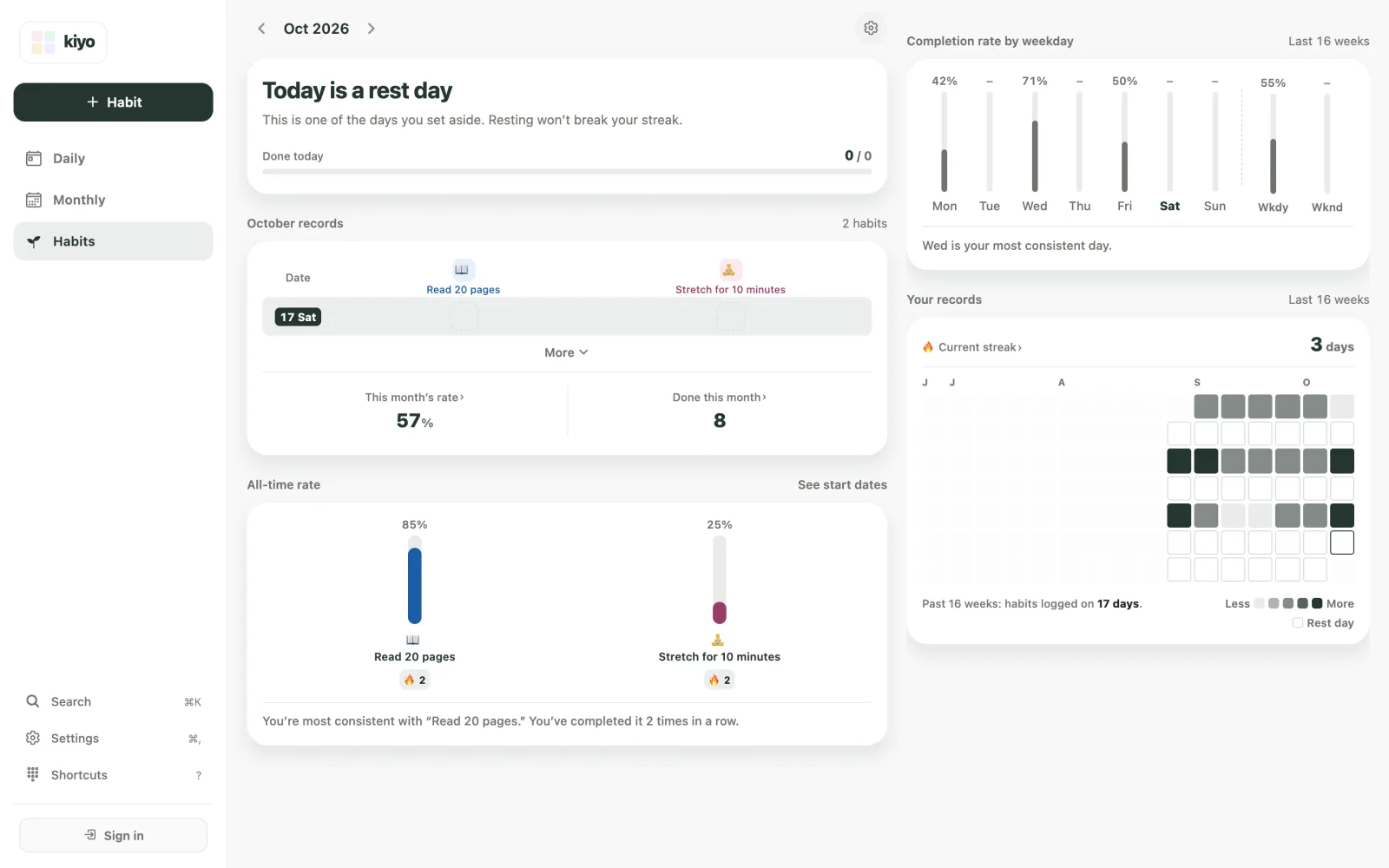
Neither number tells you why. The rate does tell you which question to ask. For reading: what happened on those three days? For stretching: is a Monday, Wednesday and Friday schedule the right plan at all?
What does each habit-tracking number tell me?
Each number covers a different stretch of time, so they can tell different stories without contradicting each other. Here is what Kiyo's Habits screen shows:
| Number | Question it answers | What it counts in Kiyo |
|---|---|---|
| 🔥 badge under each habit | Am I on a run with this habit? | That habit's check-ins in a row on its scheduled days |
| Current streak | How long has my run of active days lasted? | Calendar days across all habits, ended by a scheduled day with nothing checked |
| This month's rate | How is this month going? | Check-ins ÷ scheduled days, all habits, from the 1st to today |
| Done this month | How much did I do this month? | Total check-ins, all habits |
| All-time rate | How is this habit going overall? | Check-ins ÷ scheduled days since the habit's start date |
| Completion rate by weekday | Which days do I keep? | All habits, last 16 weeks, not counting today |
That's why the demo shows two different streak numbers. Each habit's badge says 2: two check-ins in a row. Current streak, in the Your records card, says 3 days: Wednesday through Friday, with the Thursday rest day in between counted as part of the run. Rest days never break either one.
Which days should count?
Only the days you scheduled. A habit set for Monday, Wednesday and Friday shouldn't count Tuesday as a miss. In Kiyo, days you don't pick are rest days, and days before a habit starts or after it ends don't count at all.
You choose those days when you create the habit: turn on Specific days and pick the weekdays. If you can't realistically do something every day, a schedule you can keep gives a more honest record than a daily plan you keep missing.
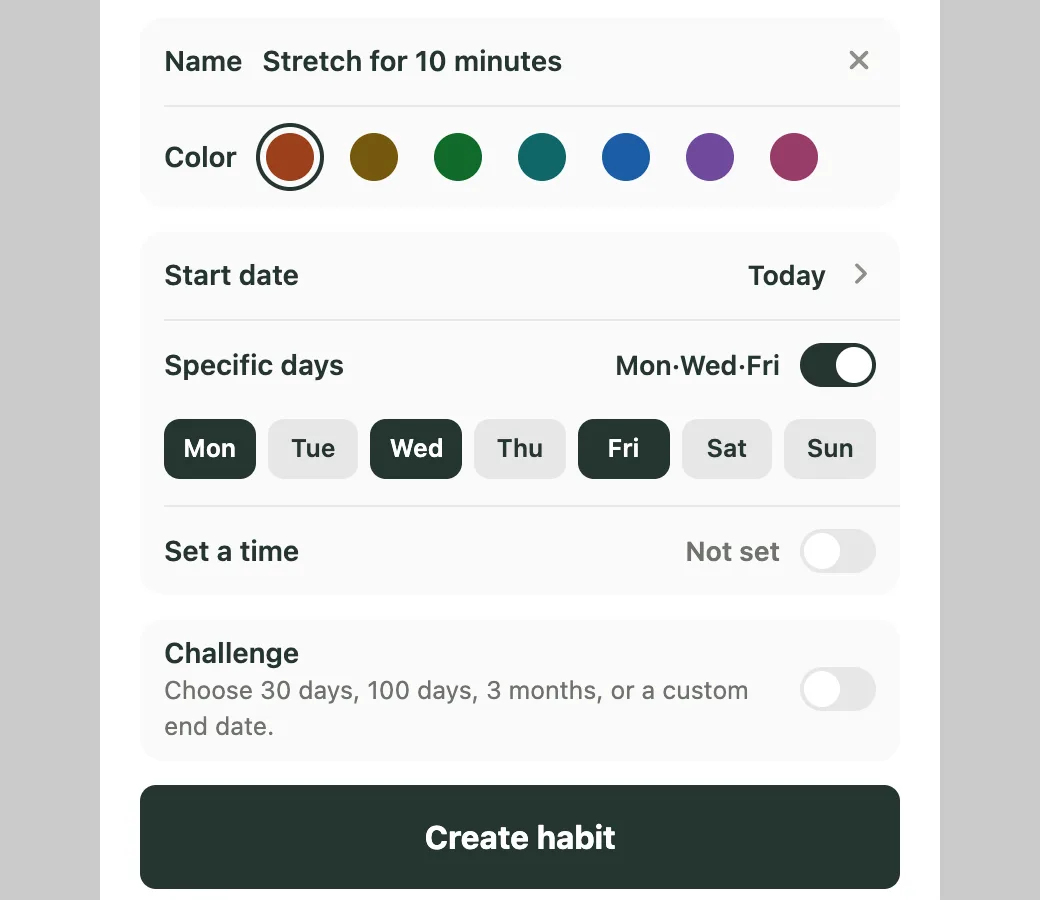
For more on why a habit's schedule matters when tracking a streak, see habit tracker or recurring calendar event. Habit tracking in Kiyo shows how the different kinds of days look in the record.
What does Kiyo show after a missed day?
A short message reminding you that your record is still there. When your run has just ended, the top of the Habits screen reads Nothing was erased: "Everything you've done is still here. You can pick it up again today." After a longer gap, it says Your habits are still here instead.
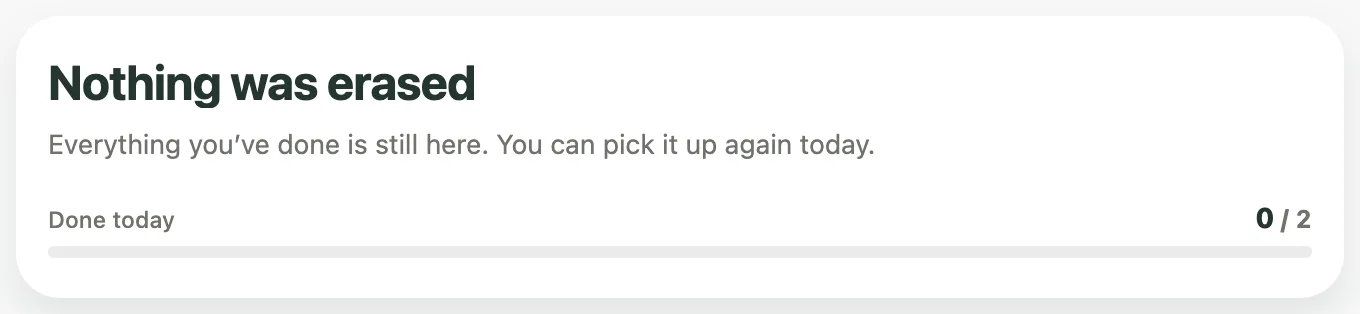
Kiyo has no streak freeze. It records the days as you log them: if you did the habit but forgot to check it off, you can still check off that past scheduled day. Future days can't be checked in advance.
How can weekday patterns help you adjust the schedule?
Look at which weekdays you keep and which you miss before you change anything. In the demo, Wednesday is the most consistent day at 71% and Monday the least at 42%. Stretching hasn't happened on a single Monday.
The chart can't tell you why. A packed Monday morning is a likely reason, but check it against your calendar before deciding. Then try one change for a few weeks: move the habit to another day, make it smaller on busy days, or keep the schedule and simply restart on the next scheduled day.
If you have less energy than usual for a whole week rather than on a particular day, how to plan a low-energy day covers what to keep and what to move. To look at habits alongside the rest of your month, try a monthly review.
Common questions
What should I do after breaking a habit streak?
Do the habit on its next scheduled day, and keep that session small if you need to. Then check whether the miss was a one-off or part of a pattern, such as the same weekday every week.
Is a completion rate better than a streak?
They answer different questions. A streak counts consecutive check-ins on scheduled days, while a completion rate counts how many scheduled days you completed. Looking at both gives a fairer picture than either alone.
What does "never miss twice" mean?
It's a popular habit rule of thumb: missing once is normal, so make the next scheduled day a priority to stop one miss from becoming a pattern. For a habit on specific weekdays, "twice" means two scheduled days in a row, not two calendar days.
How long does it take to form a habit?
Usually longer than the popular 21 days. In Lally and colleagues' 2010 study, the median was 66 days, with a range of 18 to 254 days. A 2024 systematic review found medians of 59 to 66 days and individual times from 4 to 335 days.
Does Kiyo let you freeze or repair a streak?
No. Kiyo records the days as you log them. Days you didn't schedule are rest days and never break a streak, and if you did the habit but forgot to log it, you can check off that past scheduled day.